
Report on the 2025 International Zeolite Conference
Wakihara Laboratory, The University of Tokyo
発行日:2025年10月15日Published: October 15, 2025
© 2025 一般社団法人日本ゼオライト学会© 2025 Japan Zeolite Association
The 21st International Zeolite Conference (IZC) was held from July 14 to July 18, 2025, in Dalian, China. As one of the largest and most influential conferences in the field of porous materials, the conference brought together researchers from all over the world. The event was jointly organized by Jilin University and the Chinese Zeolite Association (CZA), with the aim of advancing global collaboration and knowledge exchange in zeolite science and its industrial applications.
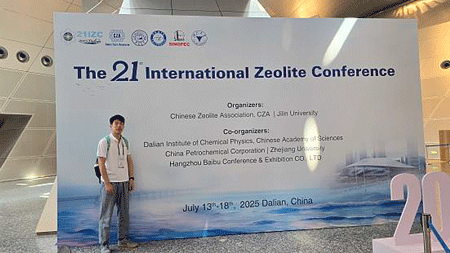
The conference featured six parallel sessions running simultaneously throughout the week. Topics covered wide and cutting-edge research areas, including zeolite synthesis, advanced characterization techniques (e.g., operando spectroscopy, synchrotron radiation), catalytic applications, gas adsorption and separation, direct air capture (DAC), and computational modeling. In addition to plenary and keynote lectures by internationally renowned scholars, the program included oral presentations and poster sessions, offering rich opportunities for academic exchange and industry interaction.
During the conference, I explored a wide range of research themes and technological innovations. What impressed me a lot were the presentations on the rational design of zeolite structures and advanced separation mechanisms. Additionally, in the gas separation sessions, several talks addressed the role of zeolites in separating small molecules such as CO2, CH4, and C2H2.
Operando spectroscopy emerged as a particularly exciting topic. On the first day, Dr. Bert Weckhuysen delivered a compelling plenary lecture titled “Operando Spectroscopy and Microscopy of Zeolite-Based Catalysts.” His presentation showcased real-time characterization of intermediate and phase transformations. Similarly, Dr. Zhu’s study using operando X-ray absorption spectroscopy (XAS) provided detailed insights into copper species in Cu-ERI zeolites, showing that the Cu/Al ratio critically affects reducibility and methanol productivity.
Prof. Wang presented a breakthrough in the single-pass conversion of syngas to C2 oxygenates by developing a dual-site methanol–carbonylation catalyst. This system reduced the CO/CH3OH ratio requirement from ≥30/1 to ~2, enabling high CO conversions and ~90% selectivity for acetic acid or ethanol—an unprecedented achievement.
Prof. Shang introduced the molecular trapdoor mechanism, enabling invertible separation of Xe and Kr by tuning door-keeping cations in LTA zeolites. This innovative concept challenges conventional sieving logic and offers promising applications in noble gas separation.
During the conference, I also presented a poster titled “Two-Order-of-Magnitude Enrichment of Trace N2O in Sludge Sintering Exhaust Gas Using 13X Zeolite.” My research focuses on the selective separation of CO2 and N2O using cost-effective 13X zeolite under industry-resembling conditions. During the poster session, I received valuable feedback from many researchers.
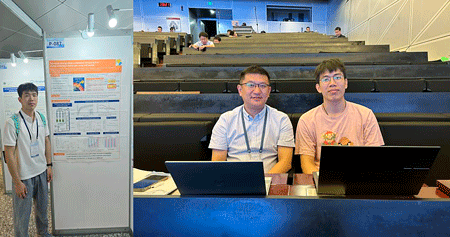
In particular, I had a meaningful discussion with Prof. Xu, an expert in XRD refinement. His practical advice and experience were highly relevant to my research, especially in the structural analysis of ion-exchanged zeolites. The insights I gained will directly support the advancement of my ongoing work.
Participating in the conference was an invaluable experience. The opportunity to contact leading experts and learn about cutting-edge advancements has expanded my academic vision and strengthened my commitment to research. In the future, I aim to integrate advanced characterization techniques into my investigations. The concepts and technologies I encountered—such as trapdoor adsorption—offer exciting pathways for improving gas separation performance.
This page was created on 2025-10-09T13:38:01.933+09:00
This page was last modified on
このサイトは(株)国際文献社によって運用されています。