
Report on the 21st International Zeolite Conference (21st IZC)
Yokoi Laboratory, Institute of Science Tokyo
発行日:2025年10月15日Published: October 15, 2025
© 2025 一般社団法人日本ゼオライト学会© 2025 Japan Zeolite Association
The 21st International Zeolite Conference (IZC2025), held in the picturesque city of Dalian, China, marked a landmark event in the field of zeolite science and technology. Bringing together leading experts, researchers, and industry professionals from around the world, the conference provided a vibrant platform for the exchange of cutting-edge research, innovative ideas, and collaborative opportunities. As a participant, I found the conference to be an exceptional academic experience that significantly deepened my understanding of current advances in zeolite research, particularly in titanosilicate zeolites and their catalytic performance. The event also offered valuable opportunities for in-depth discussions with distinguished scientists, allowing me to explore the future directions of zeolite development. During the conference, I presented my recent work on enhancing the catalytic performance of Ti-Beta zeolites through post-synthetic modification using ammonium fluoride in methanol solutions. This study focused on the application of the modified zeolites in the epoxidation of cyclohexene with hydrogen peroxide, demonstrating notable improvements in catalytic activity.
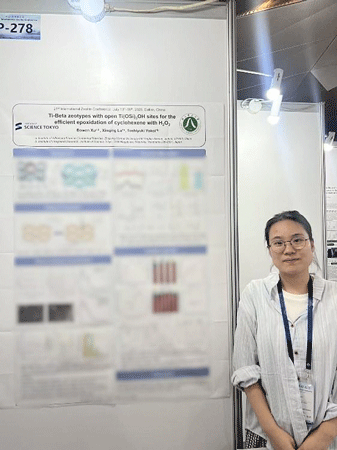
Personally, one of the highlights of the conference was the opportunity to present a poster showcasing my latest research, which focuses on the regulation and characterization of titanium active sites in titanosilicate zeolites and their application in the epoxidation of cyclohexene. My presentation, titled “Ti-Beta zeotypes with open Ti(OSi)3OH sites for the efficient epoxidation of cyclohexene with H2O2” attracted significant interest from both experimental and computational researchers. The ensuing discussions were both insightful and stimulating, with attendees offering valuable feedback and perspectives on potential future research directions. This session underscored the critical role of fundamental material design in addressing practical industrial challenges, particularly in catalysis and energy conversion. In addition to my own presentation, the keynote and plenary sessions provided a wealth of insights into the latest advancements in zeolites research. Renowned scientists shared pioneering work on novel synthetic methodologies.
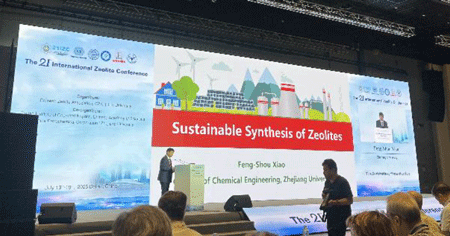
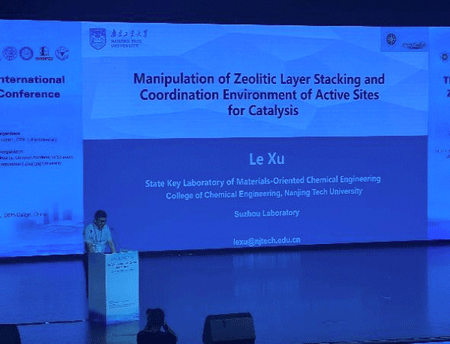
One of the most compelling discussions at IZC2025 centered on the interdisciplinary applications of zeolites, which significantly broadened my understanding of their potential beyond traditional roles in catalysis and adsorption. For instance, Professor Feng-shou Xiao presented innovative work on the sustainable synthesis of zeolites. Another noteworthy presentation focused on the regulation of titanium coordination states to synthesize six-coordinated titanium species, which exhibited enhanced performance in olefin epoxidation reactions. This topic resonated strongly with my own research interests.
The ensuing discussions were thought-provoking and inspiring, sparking ideas for possible future collaborations. These interdisciplinary explorations highlighted the remarkable versatility of zeolites and their potential to address a wide array of global challenges, particularly those related to environmental sustainability. Another fascinating aspect of the poster sessions was the emphasis on computational modeling and simulation. Several researchers presented advanced techniques for predicting the structure and behavior of zeolites, enabling the rational design of materials with specific functionalities prior to actual synthesis. The integration of computational tools with experimental research is undoubtedly a promising direction for the future of zeolite science-one that I am eager to explore further in my own work.
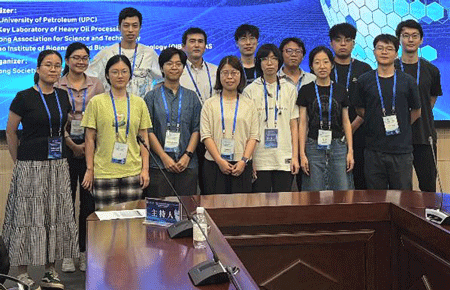
These interactions offered valuable insights into novel synthesis strategies and catalytic applications of zeolites and facilitated in-depth discussions on potential collaborations that could integrate our complementary research strengths. I am sincerely grateful to the Japan Zeolite Association (JZA) for their generous financial support, which enabled my participation in this high-level international conference and allowed me to gain a broader perspective on recent global advancements in zeolite science.
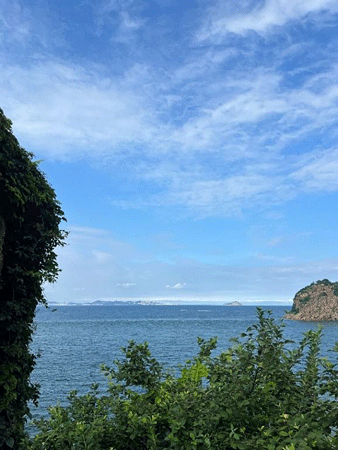
In addition to the conference’s intellectually rigorous program, the city of Dalian left a lasting impression with its natural beauty, cultural richness, and historical depth. Under the thoughtful guidance of the conference organizers, participants had the opportunity to explore the city’s stunning coastal landscapes, notable historical sites, and vibrant local culture. From the serene views of the coastline from Bangchui Island to informal conversations with researchers from across the globe, these experiences provided an ideal setting for relaxed yet meaningful academic exchange, fostering both collegiality and the prospect of future collaboration. The city’s cultural and historical context added a distinctive humanistic dimension to the overall conference experience, rendering the journey not only academically rewarding but also personally enriching.
The 21st International Zeolite Conference was an immensely rewarding experience, providing me with the opportunity to learn from leading experts in the field of zeolite research and to share my own findings with the scientific community. The conference served as a valuable platform for the exchange of ideas, the exploration of emerging research directions, and the establishment of enduring connections with scholars from around the world.
This page was created on 2025-10-08T12:44:06.299+09:00
This page was last modified on
このサイトは(株)国際文献社によって運用されています。