
Report of the IZC
Ogura Laboratory, The University of Tokyo
発行日:2025年10月15日Published: October 15, 2025
© 2025 一般社団法人日本ゼオライト学会© 2025 Japan Zeolite Association
The 21st International Zeolite Conference (21st IZC) was held from July 13th to 18th, 2025, in Dalian, China. Together with Prof. Ogura Masaru and Dr. Taeyi Nam, we joined this conference which focus on the microporous and mesoporous materials and their application.
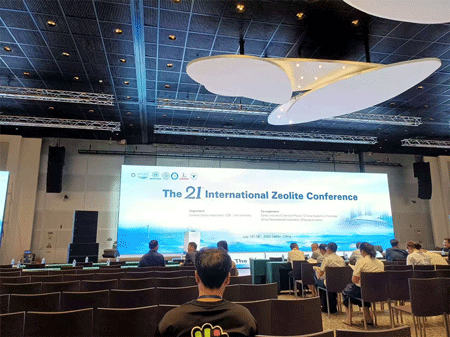
This conference has totally 5 plenary speakers and I am impressed by the lecture that given by Prof. Fengshou Xiao. The title of the lecture is sustainable synthesis of zeolites. Prof. Xiao introduced different kinds of method that can be used in the synthesis of zeolites without using organic structure directing agent OSDA). By reducing the usage of OSDA, the cost and pollutions during the production of zeolite can be decreased. In addition, not only the small-scale synthesis was done in the laboratory, but also the scaled-up equipment that can be using in industrial was developed. As a Ph.D. student in university, I always think about the results that obtained from the experiments and how to write them to a journal article. Prof. Xiao’s lecture noticed me that the real application is also very important. We need to think about how our research results can be used in the real application.
Another plenary lecture I want to mention is given by Prof. Christopher W Jones from Georgia Institute of Technology. The title of his lecture is direct air capture of carbon dioxide with nanoporous materials. Nowadays, large amount of greenhouse gas is released in to the atmosphere and the global temperature raised rapidly. To solve this problem, the technology of CO2 capture and utilization need to be developed. Prof. Christopher W Jones use modified nanoporous materials which contain different kinds of amine groups. First, he studied the CO2 adsorption behavior of primary, secondary and tertiary amine. After that, the effect of amine amount was also considered. Since this type of material is used in the air atmosphere. The effect of O2 and H2O was also discussed. His works on this topic were developed step by step and I think it is best to carry out the research based on the logistic and finally a couple of systemic works can be done.
On the evening of the 15th, I attended the poster presentation and discussed the topic of partial oxidation of CH4 with students from KU Leuven. They used Cu-based zeolites, which could oxidize CH4 to methanol at low temperatures using oxygen. In contrast, Fe-based zeolites could not catalyze the reaction between CH4 and oxygen, and could only catalyze the reaction between CH4 and N2O. The difference in this property between Cu-based and Fe-based zeolites is a very interesting research topic. It gave me a clearer understanding of my future research direction.
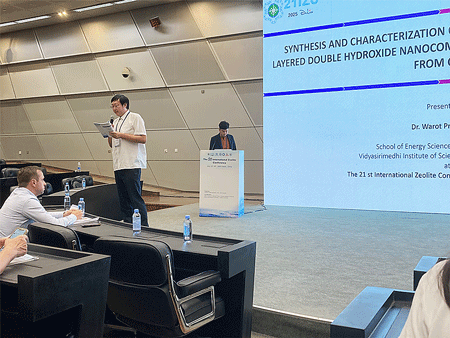
On July 16th, before I present my work, I first become the chair of one secession. As the Chair of the session before my presentation, I was responsible for introducing the speaker, managing time effectively, and facilitating a smooth and engaging academic discussion. I began by delivering a brief but informative introduction of the speaker, highlighting their background.
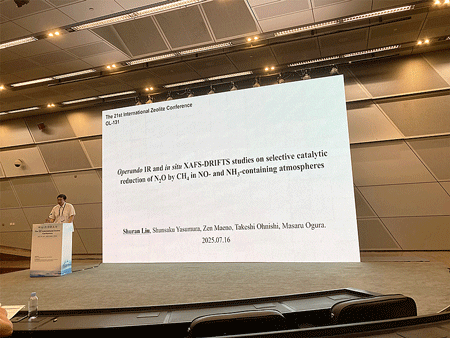
After that I present my work, about the Operando IR and in situ XAFS-DRIFTS studies on selective catalytic reduction of N2O by CH4 in NO- and NH3-containing atmospheres. This was not my first time presenting at an international academic conference, and I was very familiar with the content of my talk. I successfully completed the presentation within the allotted time. The audience asked several questions, and I responded to them accordingly.
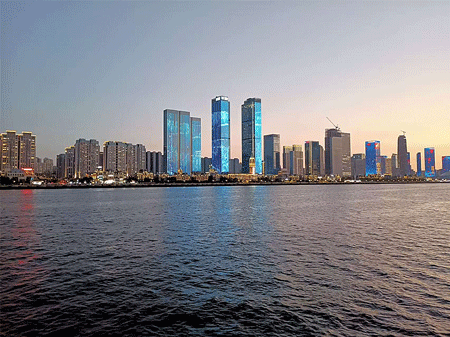
In the evening of July 17th, I attended the banquet that held by the conference. Many famous professors were also attended. The banquet was held on a cruise ship and we can enjoy the beautiful landscape of Dalian Port together with the delicious food. During the banquet, the international zeolite association presented awards to many professors who have made outstanding contributions in the field of zeolite. In addition, some professors extended their self-composed song of zeolite, whose lyrics include multiple languages, bringing joy to all the attendants which from different countries. I also exchanged research ideas with several students from the University of Hong Kong.
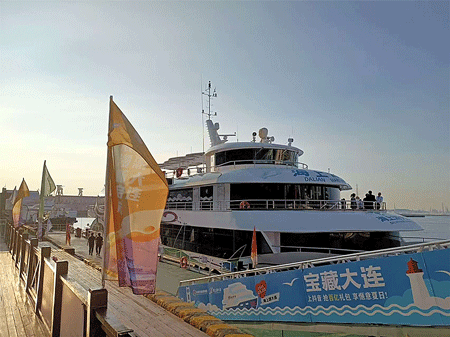
Midway through the banquet, many people went up to the upper deck of the cruise ship to enjoy the beautiful night view of Dalian and the lights on the buildings along the shore. I discussed the CH4-SCR reaction with Professor Xiangju Meng and compared the similarities and differences between their cobalt zeolites and the Fe zeolites that I am researching. Time flew by quickly, and we returned to Dalian Port as the banquet came to an end.
On the last day of the conference, I attended Prof. Jiangfeng Yang’s presentation on the adsorption of N2O and CH4. In my research, I use the reaction between N2O and CH4 to remove these two greenhouse gases, while Prof. Jiangfeng Yang’s report focused on adsorption using Fe-MOF materials. I discussed with him the issue of adsorption of these two gases on Fe zeolites.
After that, we left the venue for the airport and returned to Japan. Attending the 21st IZC broadened my international perspective, allowed me to make new friends, and deepened my understanding of my research. I sincerely thank Japan Zeolite Association (JZA) for sponsoring this trip.
This page was created on 2025-10-09T14:39:22.840+09:00
This page was last modified on
このサイトは(株)国際文献社によって運用されています。